
Fun fact about me: I am not very good at keeping my mouth shut. About, well…anything. That trait is doubled when it comes to matters that I’m passionate about, and I’m very passionate about genetic preservation of the Scottish Terrier.
I mentioned the possibility of Scotties one day requiring a genetic rescue project that involves outcrossing to other terrier breeds in my last blog post. It was well received here, mostly because this is my space and like tends to attract like. The people seeking us out have similar views on inbreeding depression and genetic predisposition of diseases. But, when I bring this idea to the wider audience of Scottish Terrier fanciers across the internet at large, I’m almost always greeted with handwringing, fist-shaking and admonishments…often by very, very influential members of the STCA. This constant source of ridicule is why I tend to hang out in friendlier areas such as The Functional Dog Collaborative.

But, I eventually end up back in the Scottie circles one way or another. I had yet another such run-in with a STCA member that I hold in high regard above all others. I’ll leave the individual nameless out of respect, but this person essentially asked me what evidence or sources I have to cite that support the idea that outcross projects would be beneficial whatsoever. Considering the fact that I took the time to write a lengthy reply with the requested sources, I thought it prudent to go ahead and host it here as well.

I’m legitimately so glad you’ve asked! I’ve researched this topic extensively. Honestly, I would love to sit down across a table and have a cup of tea to discuss this in person, but I guess Facebook comments will have to do.
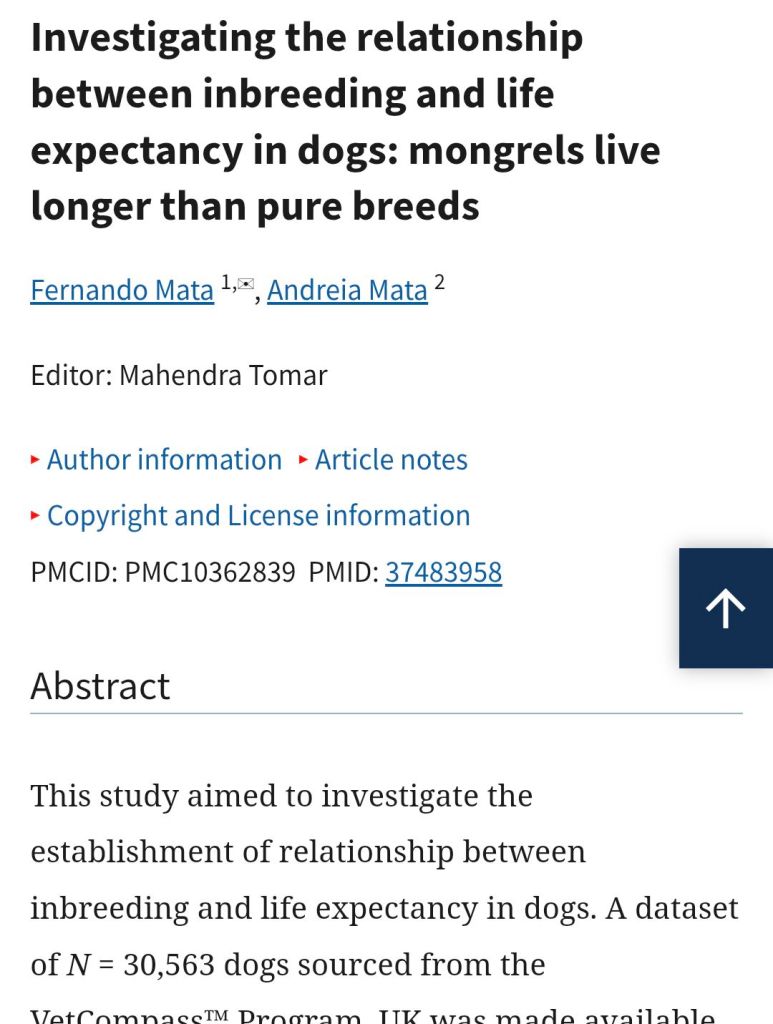
https://pmc.ncbi.nlm.nih.gov/articles/PMC10362839/#ref-4
This article is primarily based on longevity and body size, but there are interesting tidbits buried within the text body that can be teased out. First, allow me to draw your attention to this image I’ve posted at the head. According to this study, Scottish Terriers are one of the least heterozygous (or, put more simply, least generically diverse) breeds of dog on record. We know that highly homozygous animals populations are far more likely to be impacted by deleterious genetic conditions. I won’t bother to source that claim, you can Google it within ten seconds and this post is going to be long enough as it is.
We also know that populations with high coefficients of inbreeding are more likely to be impacted by genetic diseases of all inheritance patterns than lower COI populations. Estimations of average COI in Scotties varies according to source, but it’s generally agreed to be somewhere between 30-35%. This is high when compared to other dog breeds. All purebreeds overall average out to around 10-15%, which is significantly lower than our beloved little guys. Zoological based preservation programs in other species have historically set a goal of 10% COI in order to keep the breeding population healthy. Obviously, Scotties are far above this metric and the previous information about them being so highly homozygous positively correlates with their COI, as expected.
This article also shows that Scottish Terriers have a high hazard ratio compared to other breeds. Additionally, it found that mixed-breed dogs have an average life expectancy of 1.2 years longer than all purebred dog breeds. No conclusions were publicly stated regarding mixed breed longevity compared against Scottish Terriers specifically of course, but the raw data is available and easily crunched if one has the inclination to do so. I do not, as I’m already steadfast in my views on this topic, but you might.

https://pmc.ncbi.nlm.nih.gov/articles/PMC11810519/
This paper, just recently published, is a fascinating read and a call to action regarding our ailing purebreds overall. I’ll implore you to read the whole thing, but for practical purposes I’ll draw your attention to this paragraph specifically:
“The build-up of heritable diseases is a predictable result of increased homozygosity and progressive loss of genetic variation over time in closed breeding populations, no matter the species, due to selection and genetic drift. In dogs, however, some additional factors seem to have fueled the process. Many breeds were established with a limited number of founders so when the studbooks were closed – an event which occurred at variable times in different breeds and countries – the genetic variation was already small. Also, only a small proportion of each generation of dog breeds generally contributes to the next generation. Extensive use of popular sires (often dogs that have achieved extraordinary results at dog shows, utility tests or other kinds of dog sports) increases the frequency of the genetic variants they carry – including deleterious mutations – in the population. The widely promoted practice of deliberate inbreeding and line breeding – at least in the past – increased the risk of homozygosity for these variants in subsequent generations leading to the current situation with high levels of inherited disorders (Oliehoek et al. 2009; Leroy & Baumung 2011; Marsden et al. 2016; Broeckx 2020; Ikolo et al. 2023).”
Bear in mind that these effects are exponentially accelerated in the presence of a declining breeding population. We’re all aware that Scotties are becoming fewer by the year. As their numbers fall, further genetic variability will be lost and homozygosity will therefore continue to rise. This isn’t a hunch, it’s mathematical fact. While it’s true that some breeds with relatively high COIs are also relatively healthy (within the context of purebred dogs, anyway), it’s also true that these breeds tend to be more popular than ours. Scotties get the short end of the stick on both accounts.
The author goes on to list several examples of successful outcross projects that have positively impacted the health of the breed. Outcross projects such as the Irish Red and White Setter project have been wildly successful. Some breed clubs have allowed their studbooks to remain open altogether.

“The Danish Swedish farmdog was reconstructed in the 1980s and received FCI-recognition in 2019. All the way through the reconstruction process, the breed register was kept open, and still remains open by the Scandinavian kennel clubs. This means that owners of dogs showing phenotypic resemblance with the Danish Swedish farmdog can have their dog evaluated by an authorised judge and – if approved – the dog is enrolled in the breed register with a blank pedigree (DSGK 2024). The Finnish kennel club has an open breed registry for a number of other breeds, including the Jack Russell terrier, Lapponian herder, Norbottenspitz, Pyrenean sheepdogs, and Finnish lapdog. Apart from the phenotypic evaluation, entry into the breed also requires a DNA profile and testing for breed-specific hereditary diseases (FKC 2024). As a way to obtain better health, the Danish kennel club decided to open the breed registry for the English bulldog, French bulldog and pug by 1 May 2024. Entry into the registry requires a phenotypic evaluation and a maximum grade for BOAS (Brachycephalic Obstructive Airway Syndrome) of 0 or 1 (DKC 2024a).”
There is zero reason that a similar program could not be adopted for the Scottish Terrier. None whatsoever. The carrier genes of the conditions that plague our breed have not all been identified. I’m confident that they will, almost exclusively because of the work that you and [redacted] have put into the Scottie DNA bank. You’re both the biggest contributors to saving our breed, bar none. What you guys have pulled off is nothing short of remarkable, and I deeply thank you for doing what you have done and thank you in advance for what you will continue to do for our breed.
But…why should we wait for these genes to be identified at all, when there are so many stellar outcross programs to model after already? Why must our dogs get sicker, live shorter lives, and suffer more while the work to find these polygenic factors is ongoing?
And for what gain? For the sole sake of saying that our dogs are “pure?”
Are Dr. Schiable’s LUA dalmatians not “true” dalmatians? They look like Dals. They act like Dals. And more importantly: they’re healthier than the “pure” Dals. They suffer less. Isn’t that worthy of forgoing the stuffy “pure” label?

I’ve answered your question in great detail. I believe I’ve demonstrated the detrimental effects of high homozygosity and out of control COI. So now I pose a question to you as well:
What evidence do you have that our breed can be salvaged if the studbook remains closed?

 Dupplin Scotties