
Because of our occasional animal rescue work with Huntsville Animal Services, I like to keep a finger on the pulse of what’s happening in our local animal shelters. Usually I look for momma dogs with puppies or young, feral critters that could use some socialization and a soft place to land before being sent along to their forever homes. I was cruising the listings of dogs for our next prospective foster when I came across an unexpected sight: what appeared to be a Scottie, but he was listed as a ‘mixed breed’ who was notated as being picked up as a stray at a nearby marina.
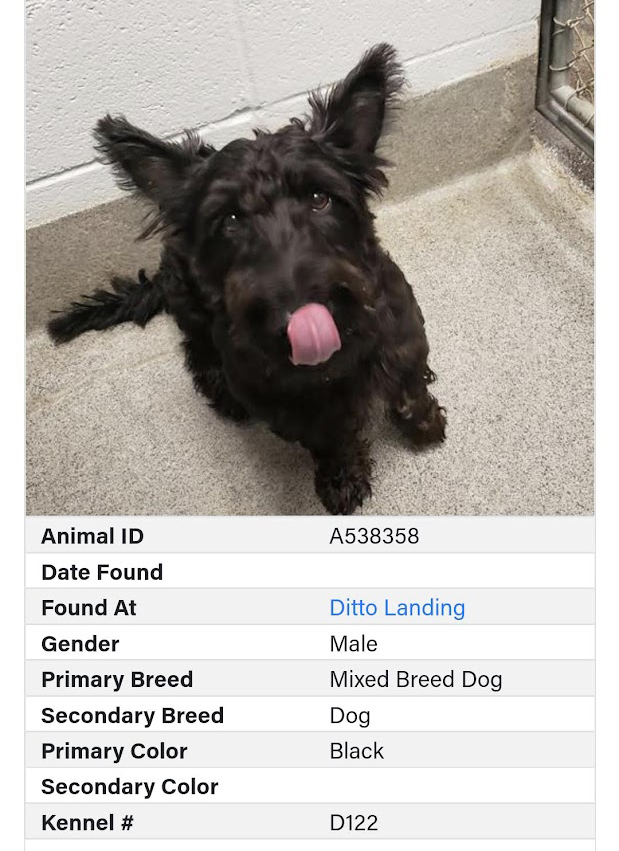
It is very unusual to see Scotties in shelters, especially ones that are purebred. Immediately, I got on the phone and spoke with Dr. Karen Sheppard, the director of Huntsville Animal Services and asked her about him. She said that they unfortunately didn’t have much more information to go by than what was listed. She said that he was friendly, intact, skinny, and filthy, and that he was found wearing a blue nylon collar that seemed to be much older than he was. He had been advertised as found for several days but had not been claimed by an owner.
Scotties are highly sensitive and intelligent dogs that deteriorate rather quickly in a shelter setting. They’re known to turn to biting when kept in isolated settings, and the last thing I wanted was for this poor boy to be euthanized for preventable behavioral issues. We immediately dropped what we were doing and headed up to meet him ourselves.
The moment we led him to the meet and greet room, he collapsed against my leg and let out the telltale “Scottie purr.” We knew right then and there that we were going to pull him, but we weren’t yet planning to keep him for ourselves. We planned to do what we always do – bring him home, socialize him, do a bit of temperament testing, training, and housebreaking, and send him on to his destined forever family.

He passed his temperament test with flying colors. He showed no signs of resource guarding, no prey behaviors with our cats, and he showed no reactivity towards Skye. Lastly, we let our oldest daughter approach him tentatively, which was met with tail-wags, jumps, and licks without an ounce of fear.
Despite his seemingly stellar natural temperament, it was immediately clear that he had never been socialized to much of anything. He fumbled and whined when we introduced him to stairs. He had never encountered toys and didn’t have the faintest idea what they were for. He wasn’t housetrained. Even worse, he seemed not to understand that we were trying to interact with him when we spoke. He never looked in our direction when we whistled or made kissy noises. Wherever this malnourished little guy had come from, he hadn’t been interacted with much at all.

Ignoring his obvious quirks, Skye set about befriending him as she always does. They romped in our fenced backyard like idiots. When it was time to come back indoors, he refused. Skye coaxed him inside by walking back and forth from us to him over and over again until he followed her in. Once inside, he had a very difficult time settling in for the night. He’d never encountered a dog bed before and didn’t even know how to lie on top of blankets. He paced endlessly that first night, as new fosters are known to do. Every time he stood up, Skye would nudge him back towards the blanket next to our bed that we’d designated as their area until it was safe to bathe him post-neutering.

Those early weeks were hard. Most foster dogs go through a period of intense decompression, and Colum’s was compounded by the fact that he was now enveloped in a world he’d never experienced before. The sound of the dishwasher was new, the concept of doors opening and closing was new, and interacting with humans was new to him as well. He escaped the house several times, resulting in intense chases that eventually ended with me purchasing an expensive GPS tracking collar out of sheer desperation. He spent a lot of time outdoors for the first month or so, just because that’s where he was the most comfortable.
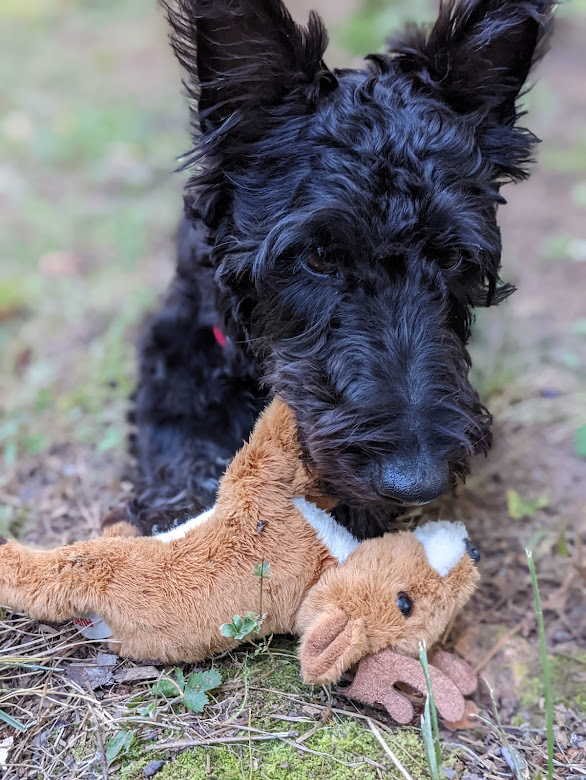
Out of the blue, the concept that toys are for playing with struck him one day. After that, we had a tool to coax him to meet us in the middle and get him to interact. I started clicker training him to look at us when we said his name, and although it took far longer than it ever has with any other of our fosters, he eventually caught on. Still, he was a wild dog that dashed for doors as soon as they opened and barked incessantly at the slightest provocation. He was the most difficult dog to crate train that I’d ever encountered. I was desperately looking forward to sending him on to our favorite rescue of choice and regaining our sense of normalcy, when suddenly, this happened.
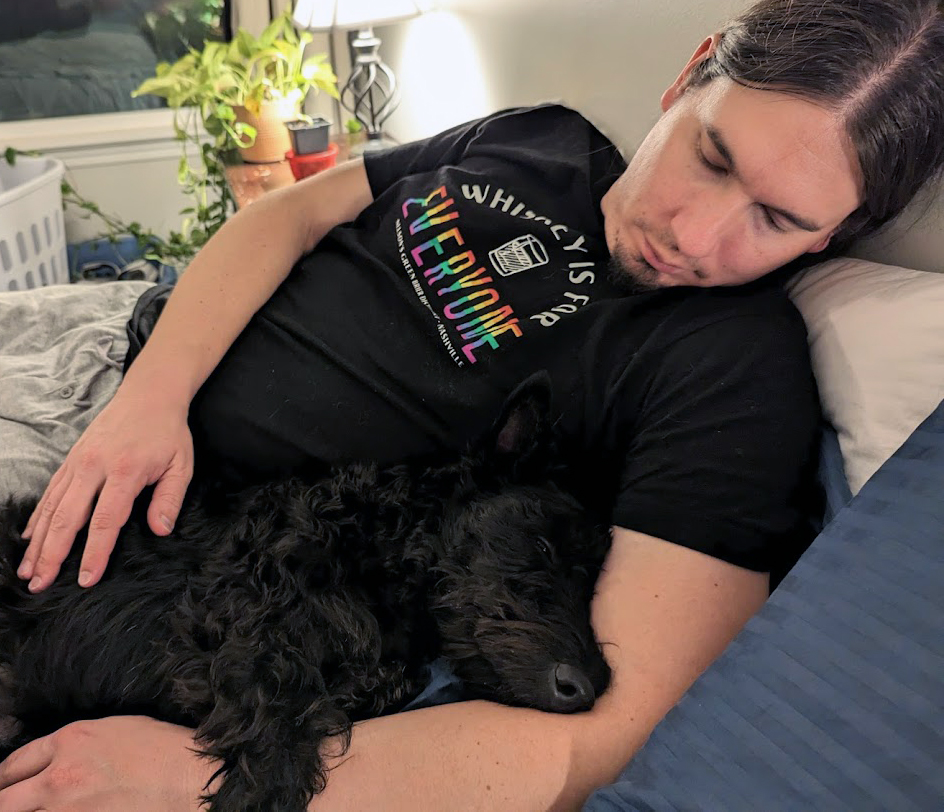
Out of nowhere, Colum decided that people were for snuggling. More specifically, Michael was for snuggling. And instantly, I knew we were doomed.
It took us another six months to get him to a basic level of training where he understood simple commands such as ‘sit.’ He still fights me on ‘stay’ to this day, and I doubt he’ll ever have as good of a handle on it as Skye does. After all, his formative puppy period was spent either lost on the streets or doing whatever he pleased. That’s a challenging habit to break, and I’m not sure I’m interested in doing so anyway.
He’s come a log way in the time we’ve had him. He now walks on a leash beautifully, always snuggles up to us regardless of whether we want him to or not, and he’s become Skye’s constant companion. He’s still Michael’s dog first and mine second. He’s now at a healthy weight and his coat quality has improved dramatically. In May, he’ll begin therapy dog training with Skye in the hopes that sharing his snugglebug self with others will bring them a measure of comfort during challenging times.


 Dupplin Scotties
1 Comment